HeirDoor by Parcel · inherited house guide
Inherited a house in Texas? Here's the probate timeline.
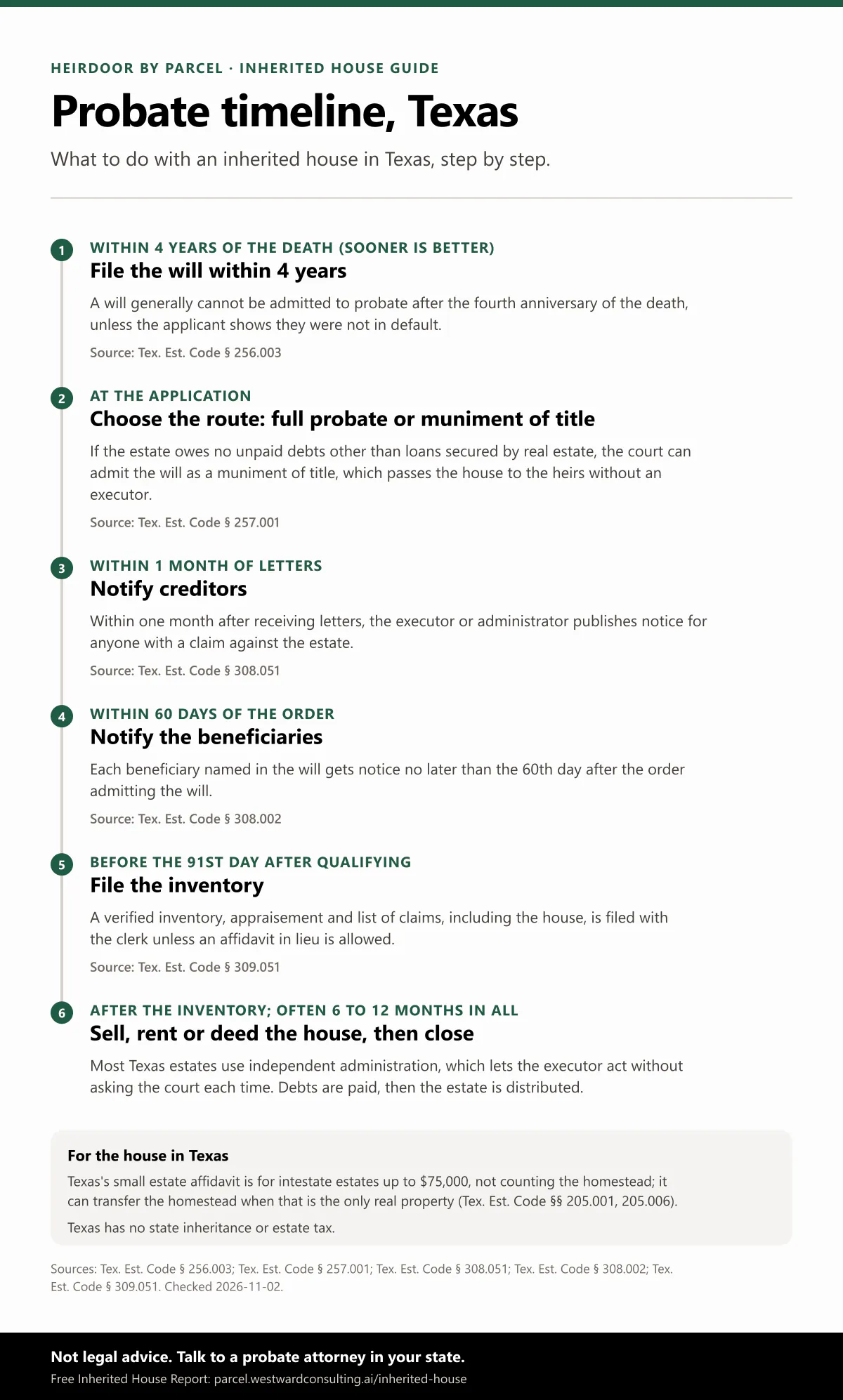
Probate steps in Texas
The estate is handled by the county's probate court, or the county court acting as one (statutory probate courts in the large counties).
1. Within 4 years of the death (sooner is better)
File the will within 4 years
A will generally cannot be admitted to probate after the fourth anniversary of the death, unless the applicant shows they were not in default.
Source: Tex. Est. Code § 256.003
2. At the application
Choose the route: full probate or muniment of title
If the estate owes no unpaid debts other than loans secured by real estate, the court can admit the will as a muniment of title, which passes the house to the heirs without an executor.
Source: Tex. Est. Code § 257.001
3. Within 1 month of letters
Notify creditors
Within one month after receiving letters, the executor or administrator publishes notice for anyone with a claim against the estate.
Source: Tex. Est. Code § 308.051
4. Within 60 days of the order
Notify the beneficiaries
Each beneficiary named in the will gets notice no later than the 60th day after the order admitting the will.
Source: Tex. Est. Code § 308.002
5. Before the 91st day after qualifying
File the inventory
A verified inventory, appraisement and list of claims, including the house, is filed with the clerk unless an affidavit in lieu is allowed.
Source: Tex. Est. Code § 309.051
6. After the inventory; often 6 to 12 months in all
Sell, rent or deed the house, then close
Most Texas estates use independent administration, which lets the executor act without asking the court each time. Debts are paid, then the estate is distributed.
For the house in Texas
- Texas's small estate affidavit is for intestate estates up to $75,000, not counting the homestead; it can transfer the homestead when that is the only real property (Tex. Est. Code §§ 205.001, 205.006).
- Texas has no state inheritance or estate tax.
Before anyone is appointed
- Secure the house. Lock up, take photos of every room, stop mail from piling up, and keep heat on in winter so pipes don't freeze. Don't remove or sell belongings yet.
- Call the homeowner's insurer. Tell them the owner died. Many policies limit coverage when a home sits empty, so ask what is needed to keep it covered.
- Find the will and the deed. Look for a will, a trust, a transfer-on-death deed or a joint deed. A house held in a trust or with a survivor on the deed may not need probate at all.
- Keep the bills current. Property taxes, the mortgage (if any), insurance and utilities keep coming due. Track who pays what; the estate usually pays it back.
Sources: Tex. Est. Code § 256.003; Tex. Est. Code § 257.001; Tex. Est. Code § 308.051; Tex. Est. Code § 308.002; Tex. Est. Code § 309.051.
This report organizes public records and general information. It is not legal, tax or financial advice, and it is not an appraisal. Talk to a probate attorney in your state before acting.