HeirDoor by Parcel · inherited house guide
Inherited a house in California? Here's the probate timeline.
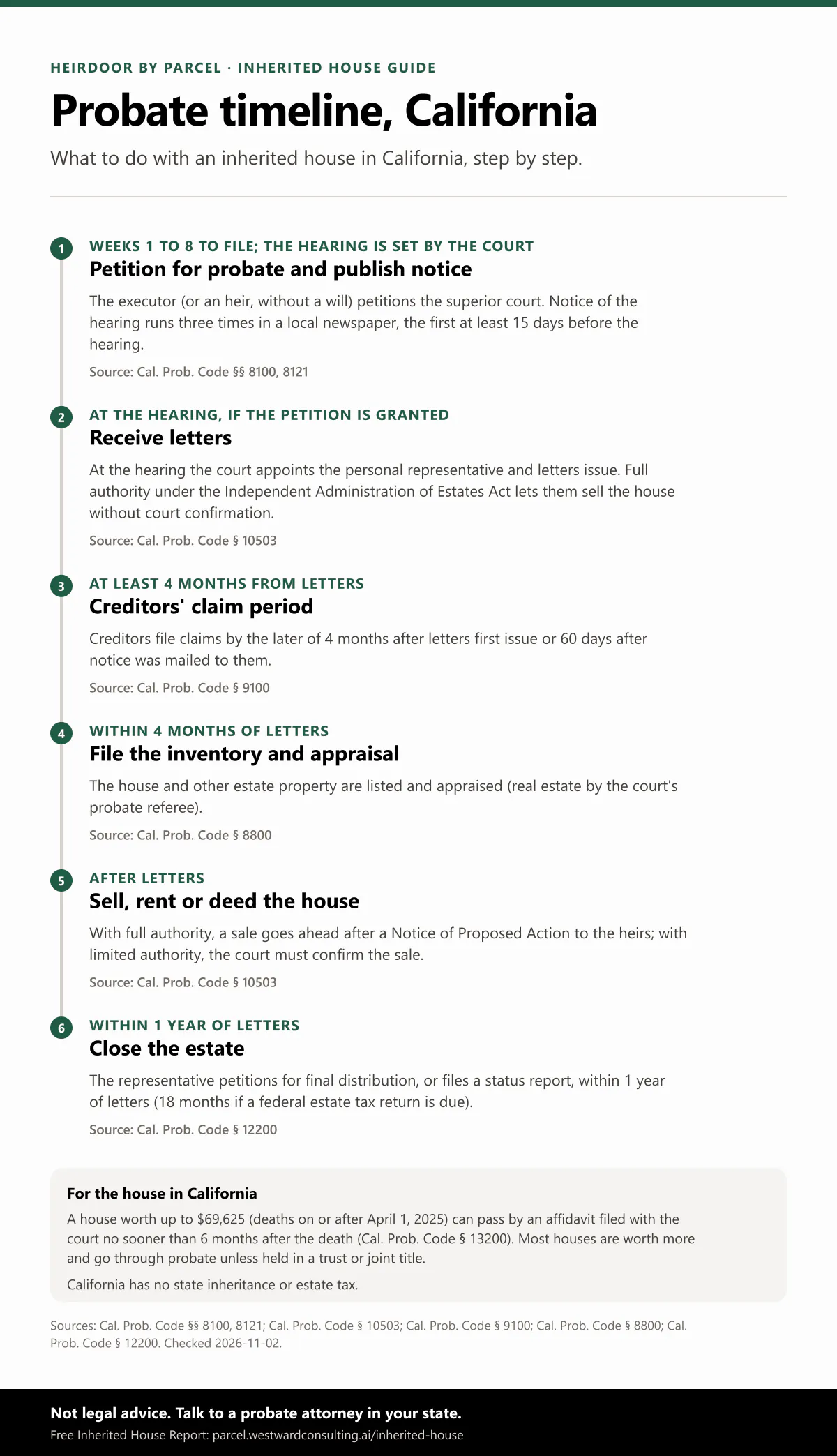
Probate steps in California
The estate is handled by the probate department of the superior court of the county where the person lived.
1. Weeks 1 to 8 to file; the hearing is set by the court
Petition for probate and publish notice
The executor (or an heir, without a will) petitions the superior court. Notice of the hearing runs three times in a local newspaper, the first at least 15 days before the hearing.
Source: Cal. Prob. Code §§ 8100, 8121
2. At the hearing, if the petition is granted
Receive letters
At the hearing the court appoints the personal representative and letters issue. Full authority under the Independent Administration of Estates Act lets them sell the house without court confirmation.
Source: Cal. Prob. Code § 10503
3. At least 4 months from letters
Creditors' claim period
Creditors file claims by the later of 4 months after letters first issue or 60 days after notice was mailed to them.
Source: Cal. Prob. Code § 9100
4. Within 4 months of letters
File the inventory and appraisal
The house and other estate property are listed and appraised (real estate by the court's probate referee).
Source: Cal. Prob. Code § 8800
5. After letters
Sell, rent or deed the house
With full authority, a sale goes ahead after a Notice of Proposed Action to the heirs; with limited authority, the court must confirm the sale.
Source: Cal. Prob. Code § 10503
6. Within 1 year of letters
Close the estate
The representative petitions for final distribution, or files a status report, within 1 year of letters (18 months if a federal estate tax return is due).
Source: Cal. Prob. Code § 12200
For the house in California
- A house worth up to $69,625 (deaths on or after April 1, 2025) can pass by an affidavit filed with the court no sooner than 6 months after the death (Cal. Prob. Code § 13200). Most houses are worth more and go through probate unless held in a trust or joint title.
- California has no state inheritance or estate tax.
Before anyone is appointed
- Secure the house. Lock up, take photos of every room, stop mail from piling up, and keep heat on in winter so pipes don't freeze. Don't remove or sell belongings yet.
- Call the homeowner's insurer. Tell them the owner died. Many policies limit coverage when a home sits empty, so ask what is needed to keep it covered.
- Find the will and the deed. Look for a will, a trust, a transfer-on-death deed or a joint deed. A house held in a trust or with a survivor on the deed may not need probate at all.
- Keep the bills current. Property taxes, the mortgage (if any), insurance and utilities keep coming due. Track who pays what; the estate usually pays it back.
Sources: Cal. Prob. Code §§ 8100, 8121; Cal. Prob. Code § 10503; Cal. Prob. Code § 9100; Cal. Prob. Code § 8800; Cal. Prob. Code § 12200.
This report organizes public records and general information. It is not legal, tax or financial advice, and it is not an appraisal. Talk to a probate attorney in your state before acting.